Neden Hem -dB Hem +dB Var?
dB referans noktasına göre artı veya eksi olabilir. Clipping nedir, 0 dBFS ne anlama gelir?
Kulağın sırları — Beyniniz duyduğunu nasıl yorumlar
Psikoakustik kavramlar, teknik ölçümler ve cihaz testleri. Müziği sadece duymak değil, anlamak için.
Ses gücü gerçekte ne anlama gelir? dB bir miktar değil, bir karşılaştırmadır.
TemelFiziksel ses şiddeti ile kulağın algısı neden aynı şey değildir?
Temelİnsan kulağı tüm frekansları eşit duymuyor. Phon nedir, eğriler ne anlatır?
TemelSpotify ve YouTube neden dB kullanmıyor? Yayın platformları sesi nasıl normalize eder?
OrtaDynamic range, distortion, transparency, soundstage — gerçek hi-fi ne demektir?
İleriBir titreşimin müziğe dönüşme yolculuğu.
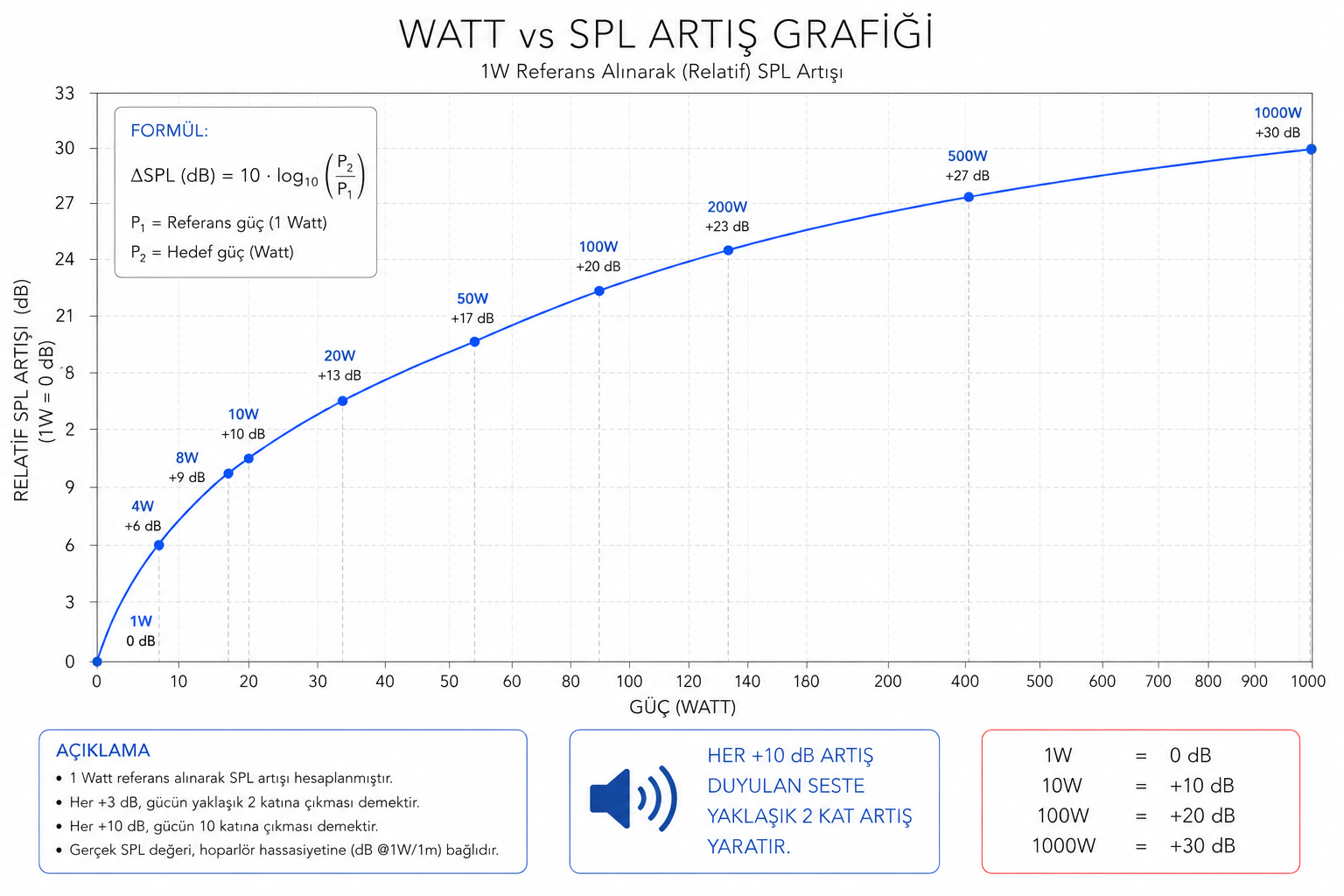
OrtaBir hoparlörün kutusundaki "100W" size ne anlatır? Çoğu insan bunu "güçlü ses" olarak okur. Ama bu sayı tek başına hiçbir şey söylemez — çünkü dB bir miktar değil, bir karşılaştırmadır.
dB nedir? Desibel (dB) mutlak bir değer değildir. Her zaman iki değer arasındaki logaritmik oranı anlatır. "Bu ses kaç dB?" sorusunun anlamlı olabilmesi için mutlaka bir referans noktası gerekir.
1W'tan 10W'a geçtiğinizde oran 10/1 = 10, sonuç +10 dB. 10W'tan 100W'a geçtiğinizde yine +10 dB. Yani her +10 dB, gücün 10 katına çıkması demektir.
SPL nedir ve neden 20 log kullanılır? SPL (Sound Pressure Level) hoparlörden çıkan fiziksel ses basıncını ölçer. Birimi aslında Pascal'dır — ama aralık çok geniş olduğu için logaritmik ölçeğe geçilir:
Güç oranlarında 10 log, basınç oranlarında 20 log kullanılır. Çünkü akustik güç, basıncın karesiyle orantılıdır.
Kulağın algısı farklı çalışır:
| Değişim | Fiziksel etki | Kulağın algısı |
|---|---|---|
| +3 dB | Güç 2× | Biraz daha yüksek |
| +10 dB | Güç 10× | ~2× daha yüksek |
| +20 dB | Güç 100× | ~4× daha yüksek |
1000W'lık bir sistem, 100W'lıktan yalnızca +10 dB daha yüksek — kulağa sadece iki kat gibi gelir. Elektriksel güç artışı ile psikoakustik algı aynı şey değildir.
A loudspeaker's "100W" rating tells you very little on its own — because dB is not a quantity, it's a comparison.
What is dB? Decibel (dB) is not an absolute value. It always expresses the logarithmic ratio between two values. The question "how many dB is this sound?" only makes sense with a reference point.
Going from 1W to 10W gives a ratio of 10/1 = 10, resulting in +10 dB. Going from 10W to 100W is also +10 dB. So every +10 dB means the power has increased tenfold.
What is SPL and why use 20 log? SPL (Sound Pressure Level) measures the physical sound pressure from a speaker. Its unit is actually Pascal — but since the range the human ear can hear is enormous, we use a logarithmic scale:
For power ratios we use 10 log, for pressure ratios we use 20 log — because acoustic power is proportional to the square of pressure.
The ear perceives differently:
| Change | Physical effect | Perceived loudness |
|---|---|---|
| +3 dB | Power 2× | Slightly louder |
| +10 dB | Power 10× | ~2× louder |
| +20 dB | Power 100× | ~4× louder |
A 1000W system is only +10 dB louder than a 100W one — the ear perceives it as roughly twice as loud. Electrical power increase and psychoacoustic perception are not the same thing.
Birçok insan bu iki kavramı aynı şey sanır. Aslında farklıdırlar.
Ses seviyesi sistemin gönderdiği fiziksel ses seviyesidir — ampinin çıkış gücü, telefonun ses çubuğu, hoparlöre giden enerji. Ses seviyesi arttığında sisteme daha fazla güç gönderilir. Bu fiziksel bir değişimdir: 10W, 100W, 1000W bunlar fiziksel taraftaki değişimlerdir.
Loudness ise beynimizin o sesi ne kadar yüksek hissettiğidir. Bu tamamen insan kulağıyla ilgilidir — çünkü kulak her frekansı eşit duymaz, her ses seviyesini doğrusal algılamaz. 10 kat daha fazla güç, kulağa yalnızca yaklaşık 2 kat daha yüksek gelebilir. Ses seviyesi fiziksel güçtür, Loudness ise hissedilen ses yüksekliğidir.
İnsan kulağı nasıl duyar? Kulak özellikle 2–5 kHz aralığına çok hassastır. Derin basları daha zor duyar; düşük seviyelerde bas ve tizler kaybolmuş gibi hissedilir. Bazı amfilerdeki "Loudness" tuşu tam da bunu telafi etmek içindir — alçak seste bas ve tizleri artırarak kulağın doğal duyarlılık eksikliğini dengeler.
dB neden önemlidir? Ses dünyasında dB (desibel) bir miktar değil, iki değer arasındaki farktır. +3 dB ≈ 2 kat güç, +10 dB ≈ 10 kat güç — ama kulağa yaklaşık 2 kat daha yüksek gelir.
| Terim | Anlamı |
|---|---|
| Watt | Fiziksel güç |
| Ses seviyesi | Sistemin verdiği ses seviyesi |
| SPL | Ölçülen ses basıncı |
| dB | İki değer arasındaki oran |
| Loudness | Beynin algıladığı ses yüksekliği |
Bir sistem teknik olarak çok güçlü olabilir ama kulağa beklenenden çok daha az yüksek gelebilir. Çünkü insan kulağı matematiksel değil — psikolojik ve biyolojik çalışır.
Many people think these two terms mean the same thing. They don't.
Volume is the physical sound level produced by the system — the amplifier's output power, the phone's volume slider, the energy going to the speaker. When volume increases, more power is sent to the system. This is a physical change: 10W, 100W, 1000W are all physical changes on the volume side.
Loudness is how loud our brain perceives that sound. It is entirely related to the human ear — because the ear doesn't hear every frequency equally, and doesn't perceive every sound level linearly. 10 times more power may feel only about 2 times louder to the ear. Volume is physical power, Loudness is perceived loudness.
How does the human ear hear? The ear is most sensitive in the 2–5 kHz range. It hears deep bass with more difficulty; at low levels, bass and treble seem to disappear. The "Loudness" button on some amplifiers compensates exactly for this — at low volumes it boosts bass and treble, balancing the ear's natural sensitivity shortfall.
Why does dB matter? In the world of sound, dB (decibel) is not a quantity — it's the difference between two values. +3 dB ≈ 2× power, +10 dB ≈ 10× power — but perceived as only about 2× louder.
| Term | Meaning |
|---|---|
| Watt | Physical power |
| Volume | Sound level produced by the system |
| SPL | Measured sound pressure |
| dB | Ratio between two values |
| Loudness | Sound loudness perceived by the brain |
A system can be technically very powerful but feel much less loud than expected. Because the human ear doesn't work mathematically — it works psychologically and biologically.
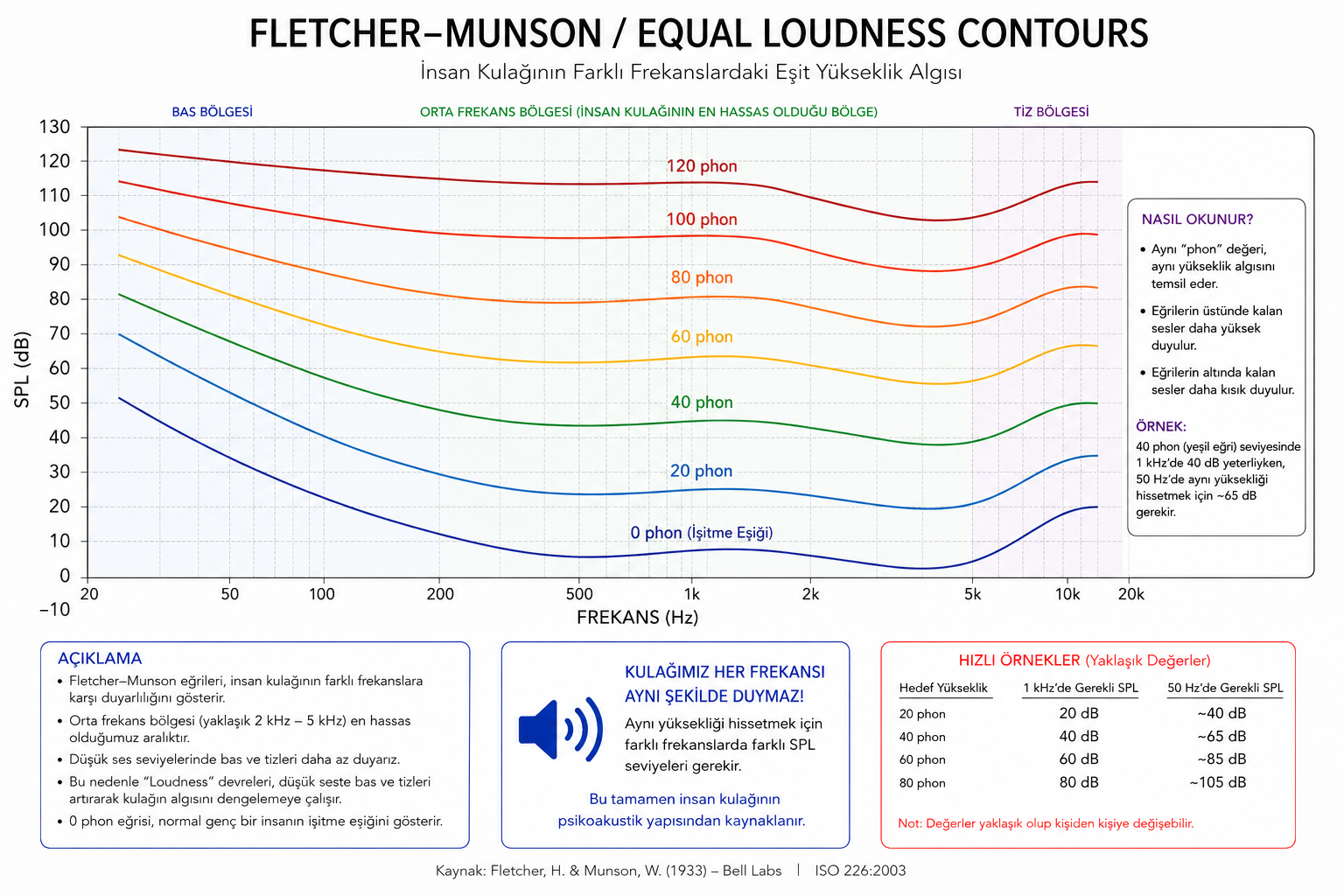
İnsan kulağı tüm frekansları eşit duymuyor. 50 Hz bas sesi ile 3 kHz orta frekans aynı SPL'de çalsa bile kulağa aynı yükseklikte gelmez.
Kulak özellikle 2–5 kHz aralığına çok hassastır. Bu bölge evrimsel olarak optimize olmuştur — konuşma, insan sesi, bebek ağlaması, alarm sesleri tam buradadır. Derin baslara ve çok tizlere ise çok daha az duyarlıyız.
Grafik ne anlatır? X ekseninde frekans (Hz), Y ekseninde gerekli SPL (dB) vardır. Her eğri "aynı yüksekliği hissedilen ses" demektir. Eğrilerin ortası aşağı çöker — kulağın en hassas olduğu bölge burasıdır. Sol taraf yükselir — derin basları daha zor duyarız. Sağ taraf da yükselir — çok tizleri de daha zor duyarız.
Phon nedir? dB fiziksel ölçümdür, phon ise insanın sesi nasıl duyduğunu anlatır. Aynı phon değeri = kulağa aynı yükseklikte gelen ses — ama fiziksel SPL değeri farklı olabilir. 1 kHz referans alınır: 40 dB @ 1 kHz = 40 phon. Ancak 50 Hz'de aynı hissi almak için 65 dB gerekebilir.
| Frekans | 60 phon için gereken SPL |
|---|---|
| 1 kHz | 60 dB |
| 10 kHz | ~70 dB |
| 50 Hz | ~85 dB |
Ses seviyesinin etkisi: Sesi düşürdüğünde basları duymak daha da zorlaşır. Müzik "ince", "ruhsuz", "bassız" duyulur. Volume yükseldikçe baslar sanki ortaya çıkıyormuş gibi hissedilir — aslında hoparlör yeni bas üretmiyordur, kulağın o frekansları daha iyi algılamaya başlıyordur.
Bu yüzden küçük Bluetooth hoparlörler mid frekansları abartır — kulağa daha "yüksek" geldiği için. Ve hi-fi tasarımında "ölçümde düz" olan sistem kulağa her zaman "doğru" gelmeyebilir. Psikoakustik tam olarak bununla ilgilenir.
| Birim | Ne ölçer |
|---|---|
| dB SPL | Gerçek fiziksel ses basıncı |
| Phon | İnsan kulağının algıladığı yükseklik |
The human ear doesn't hear all frequencies equally. A 50 Hz bass tone and a 3 kHz mid-frequency tone played at the same SPL won't sound equally loud.
The ear is most sensitive in the 2–5 kHz range. This region is evolutionarily optimized — speech, the human voice, baby crying, alarm sounds all live here. We're much less sensitive to deep bass and very high treble.
What does the graph tell us? The X axis shows frequency (Hz), the Y axis shows required SPL (dB). Each curve represents "sounds perceived at the same loudness." The middle of the curves dips — that's where the ear is most sensitive. The left side rises — we hear deep bass with difficulty. The right side also rises — very high treble is harder to hear too.
What is a Phon? dB is a physical measurement; phon describes how a human actually hears. The same phon value = sounds perceived at the same loudness — but the physical SPL may differ. Reference is taken at 1 kHz: 40 dB @ 1 kHz = 40 phon. But to get the same sensation at 50 Hz, you might need 65 dB.
| Frequency | SPL needed for 60 phon |
|---|---|
| 1 kHz | 60 dB |
| 10 kHz | ~70 dB |
| 50 Hz | ~85 dB |
The effect of volume level: As you turn the volume down, bass becomes even harder to hear. Music sounds "thin", "lifeless", "bassless". As volume rises, bass seems to emerge — the speaker isn't producing new bass; your ear is just starting to perceive those frequencies better.
This is why small Bluetooth speakers boost mid frequencies — they sound "louder" to the ear. And in hi-fi design, a system that is "flat in measurements" may not always sound "correct" to the ear. Psychoacoustics is exactly concerned with this.
| Unit | What it measures |
|---|---|
| dB SPL | Actual physical sound pressure |
| Phon | Loudness perceived by the human ear |
Kaynaklar
Bunlar müziğin temel yapı taşları ve birbirine doğrudan bağlılar.
Frekans tamamen fiziksel bir şeydir — bir ses dalgasının saniyede kaç kez titreştiğini gösterir. Birimi Hz'dir. Düşük frekans kalın/bas ses, yüksek frekans ince/tiz ses üretir.
Perde ise beynimizin frekansı nasıl algıladığıdır. İnsan kulağı perdeyi logaritmik algılar — 100 Hz'den 200 Hz'e çıkmak ile 1000 Hz'den 2000 Hz'e çıkmak ikisi de "1 oktav" gibi hissedilir. Çünkü oktav = frekansın 2 katına çıkması.
Nota, belirli pitch noktalarına verilen isimdir. Batı müziğinde oktav 12 eşit parçaya bölünür — buna "equal temperament" denir. Her yarım ses bir öncekinden yaklaşık 1.05946× daha yüksektir.
Temel notalar ve frekansları (4. oktav):
| Nota | Frekans | Nota | Frekans |
|---|---|---|---|
| C4 (Do) | 261.6 Hz | G4 (Sol) | 392.0 Hz |
| D4 (Re) | 293.7 Hz | A4 (La) | 440.0 Hz |
| E4 (Mi) | 329.6 Hz | B4 (Si) | 493.9 Hz |
| F4 (Fa) | 349.2 Hz | C5 (Do) | 523.3 Hz |
Akor, aynı anda çalınan birden fazla notadır. C Major akoru C + E + G'den oluşur. Majör akor güçlü ve neşeli, minör akor hüzünlü hissettiriyor — bunun nedeni frekans oranlarıdır. Do-Mi-Sol majörde oranlar 4:5:6, kulağa doğal ve uyumlu gelir.
Harmonikler — Bir Sesin İçindeki Sesler
Bir nota çaldığında aslında tek bir frekans çıkmaz. Kulağımıza ulaşan ses, temel frekans (fundamental) ve onun üstüne binen harmoniklerden oluşan karmaşık bir yapıdır. Örneğin 100 Hz çalarsan aynı anda şunlar üretilir:
| Harmonik | Frekans | Oran |
|---|---|---|
| 1. (temel) | 100 Hz | 1× |
| 2. harmonik | 200 Hz | 2× |
| 3. harmonik | 300 Hz | 3× |
| 4. harmonik | 400 Hz | 4× |
| 5. harmonik | 500 Hz | 5× |
Bu harmoniklerin güç dengesi her enstrümanda farklıdır — işte bu fark tınıyı (timbre) yaratır.
Timbre (Tını) Nedir?
Aynı notayı keman, piyano ve insan sesi çaldığında hepsi aynı frekansı üretir — ama kulağa çok farklı gelir. Bunun nedeni her enstrümanın harmonik spektrumunun farklı olmasıdır. Keman yüksek harmonikleri güçlü üretir, bu yüzden keskin ve parlak duyulur. Piyano ilk birkaç harmonik üzerinde yoğunlaşır, daha yuvarlak ve dolgun hissedilir. İnsan sesi ise vokal kordlarının şekline ve rezonans boşluklarına göre sürekli değişen bir harmonik yapı oluşturur.
Overtone ve Harmonik Farkı
Harmonikler temel frekansın tam katlarıdır (2×, 3×, 4×...). Overtone ise temel frekansın üstündeki tüm bileşenlerdir — tam kat olmak zorunda değildir. Zil veya davul gibi enstrümanlarda harmonik olmayan overtone'lar (inharmonic partials) bulunur — bu yüzden bu enstrümanlar belirgin bir nota hissi vermez.
Doğal Harmonikler — Gitar, Davul, Ses
Gitar telini tam ortasından hafifçe dokunarak çalarsanız temel frekans susturulur, yalnızca 2. harmonik duyulur — bu oktav harmoniktir. Telin 1/3 noktasına dokunursanız 3. harmonik ortaya çıkar. Ses tellerimiz de aynı şekilde çalışır — vokal kordlar titreşirken farklı harmonikleri güçlendiren rezonans boşlukları (göğüs, gırtlak, burun, kafa) sesi şekillendirir. Buna formant denir.
Harmoniklerin Akora Etkisi
İki nota birlikte çalındığında harmonikleri çakışırsa kulağa uyumlu gelir. Do-Sol beşlisinin güçlü ve kararlı hissettirmesinin nedeni harmonik oranlarının 2:3 gibi basit bir ilişki içinde olmasıdır. Minör ikili (yarım ton aralığı) ise harmoniklerin birbirini kestiği, kulağın çözüme muhtaç hissettiği bir gerilim yaratır.
Inharmonicity — Piyano Neden Tam Harmonik Değil?
Teoride harmonikler temel frekansın tam katları olmalıdır. Ama gerçek dünyada teller esneklik özellikleri nedeniyle harmonikleri biraz daha yüksek üretir. Buna inharmonicity denir. Piyano tellerinde bu etki oldukça belirgindir — özellikle kalın bas tellerinde. Bu yüzden piyanolar matematiksel olarak tam akortlu değildir; akortçular üst oktavları biraz yüksek, alt oktavları biraz alçak tunar. Bu yönteme stretch tuning denir. Paradoks şudur: inharmonicity piyanonun o kendine özgü zengin tınısının da kaynağıdır.
Kayıp Temel (Missing Fundamental)
Psikoakustiğin en çarpıcı fenomenlerinden biri: temel frekans hiç çalınmasa bile, harmoniklerini duyduğumuzda beynimiz o temel notayı algılar ve "tamamlar." 200 Hz, 300 Hz, 400 Hz, 500 Hz seslerini aynı anda çalarsan — 100 Hz hiç üretilmemiş olmasına rağmen — kulak bu harmonik ilişkiyi tanır ve 100 Hz'i duyuyormuş gibi hisseder.
Bu fenomen neden önemlidir? Telefon hoparlörleri 100-200 Hz altını fiziksel olarak üretemez. Ama telefonda birinin sesini duyduğunda basını hissedersin — çünkü beynin harmoniklerden temel frekansı yeniden inşa eder. Ses mühendisleri bu ilkeden yararlanarak küçük hoparlörlerde bas hissi yaratır — gerçek bas yerine harmonikler eklenir, beyin gerisini halleder. Bu fenomen şunu kanıtlar: duyma yalnızca bir fizik olayı değildir — büyük ölçüde beynin yarattığı bir yorumdur.
440 Hz mi, 432 Hz mi?
A4 = 440 Hz, 1939'da Londra'da uluslararası standart olarak kabul edildi ve ISO 16:1975 ile resmileşti. 432 Hz tartışması ise son yıllarda yoğunlaştı — savunucular "evrensel rezonans" ve şifa etkileri iddia ediyor. Ancak bilimsel tablo net: iki frekans arasındaki fark yaklaşık 31.8 cent, yarım yarıya bir yarım ton. 432 Hz'in "daha sıcak" hissettirmesi gerçek olabilir — ama bunun nedeni düşük pitch algısıdır, mistik bir özellik değil.
Diğer akort sistemleri
| Sistem | Güçlü yanı | Zayıf yanı |
|---|---|---|
| Pythagorean | Beşliler çok temiz | Üçlüler problemli |
| Just intonation | En saf akor sesi | Modülasyon yapılamaz |
| Meantone | Üçlüler güzel | Wolf interval sorunu |
| Well temperament | Her ton karakterli | Standart değil |
| Equal temperament | Evrensel, her tonda eşit | Hiçbir aralık tam saf değil |
Pentatonik sistem
Pentatonik dizi oktavı yalnızca 5 notaya böler. Dünyanın en yaygın ve en doğal hissettiren müzik sistemidir — Çin klasik müziği, Afrika davulları, Anadolu türküleri, blues, rock hepsinde vardır. Pentatonik dizideki notalar arasında "çarpışan" aralık yoktur, bu yüzden pentatonik dizide çalan biri neredeyse yanlış nota çalamaz.
C majör pentatonik: C – D – E – G – A (261.6 – 293.7 – 329.6 – 392.0 – 440.0 Hz)
Pentatonik Dizi Dairesi
Beşliler Çemberi
These are the fundamental building blocks of music and they are directly connected to each other.
Frequency is entirely physical — it shows how many times per second a sound wave vibrates. Its unit is Hz. Low frequency produces thick/bass sound, high frequency produces thin/treble sound.
Pitch is how our brain perceives that frequency. The human ear perceives pitch logarithmically — going from 100 Hz to 200 Hz and from 1000 Hz to 2000 Hz both feel like "1 octave." Because an octave = frequency doubling.
Note is the name given to specific pitch points. In Western music the octave is divided into 12 equal parts — this is called "equal temperament." Each semitone is approximately 1.05946× higher than the previous one.
Basic notes and frequencies (4th octave):
| Note | Frequency | Note | Frequency |
|---|---|---|---|
| C4 (Do) | 261.6 Hz | G4 (Sol) | 392.0 Hz |
| D4 (Re) | 293.7 Hz | A4 (La) | 440.0 Hz |
| E4 (Mi) | 329.6 Hz | B4 (Si) | 493.9 Hz |
| F4 (Fa) | 349.2 Hz | C5 (Do) | 523.3 Hz |
Chord is two or more notes played simultaneously. C Major is C + E + G. Major chords feel strong and joyful, minor chords feel melancholic — because of frequency ratios. In C-E-G major the ratios are 4:5:6, which sounds natural and harmonious to the ear.
Harmonics — Sounds Within a Sound
When a note plays, a single frequency doesn't come out. The sound reaching our ears is a complex structure of the fundamental frequency and the harmonics layered on top.
| Harmonic | Frequency | Ratio |
|---|---|---|
| 1st (fundamental) | 100 Hz | 1× |
| 2nd harmonic | 200 Hz | 2× |
| 3rd harmonic | 300 Hz | 3× |
| 4th harmonic | 400 Hz | 4× |
| 5th harmonic | 500 Hz | 5× |
The power balance of these harmonics differs in every instrument — this difference creates timbre.
What is Timbre?
When a violin, piano and human voice all play the same note, they produce the same frequency — but sound very different. The reason is that each instrument has a different harmonic spectrum. The violin produces strong high harmonics so it sounds sharp and bright. The piano concentrates on the first few harmonics, feeling rounder and fuller.
Overtone vs Harmonic
Harmonics are exact multiples of the fundamental frequency (2×, 3×, 4×...). Overtones are all components above the fundamental — they don't have to be exact multiples. Bells and drums have inharmonic partials — which is why these instruments don't give a clear sense of pitch.
Natural Harmonics
Lightly touching a guitar string at its midpoint suppresses the fundamental and only the 2nd harmonic sounds — the octave harmonic. Touching at 1/3 of the string produces the 3rd harmonic. Our vocal cords work the same way — resonance chambers (chest, throat, nose, head) shape the sound by amplifying different harmonics. This is called formant.
Effect of Harmonics on Chords
When two notes are played together and their harmonics coincide, it sounds harmonious to the ear. The C-G fifth feels so strong because harmonic ratios are in a simple 2:3 relationship. The minor second (semitone interval) creates tension where harmonics cut across each other — the ear yearns for resolution.
Inharmonicity — Why Isn't the Piano Perfectly Harmonic?
In theory harmonics should be exact multiples of the fundamental. But in reality strings produce harmonics slightly higher due to their elasticity properties. This is called inharmonicity. In pianos this effect is significant — especially in thick bass strings. This is why pianos are not mathematically perfectly tuned; tuners keep upper octaves slightly high and lower octaves slightly low. This method is called stretch tuning. The paradox: inharmonicity is also the source of the piano's uniquely rich timbre.
Missing Fundamental
One of psychoacoustics' most striking phenomena: even if the fundamental frequency is never played, when we hear its harmonics our brain perceives and "completes" that fundamental note. Play 200 Hz, 300 Hz, 400 Hz, 500 Hz simultaneously — even though 100 Hz was never produced — the ear recognizes this harmonic relationship and feels as if it's hearing 100 Hz. Phone speakers can't physically produce below 100-200 Hz. But when you hear someone's voice on a phone you feel the bass — because your brain reconstructs the fundamental frequency from the harmonics. This phenomenon proves: hearing is not just a physics event — it is largely an interpretation created by the brain.
440 Hz or 432 Hz?
A4 = 440 Hz was accepted as the international standard in London in 1939 and formalized as ISO 16:1975. The 432 Hz debate has intensified in recent years — proponents claim "universal resonance" and healing effects. But the scientific picture is clear: the difference between the two frequencies is approximately 31.8 cents, half of a semitone. 432 Hz may genuinely feel "warmer" — but this is due to the lower pitch perception, not any mystical property of the frequency.
Other Tuning Systems
| System | Strength | Weakness |
|---|---|---|
| Pythagorean | Very clean fifths | Problematic thirds |
| Just intonation | Purest chord sound | Cannot modulate |
| Meantone | Beautiful thirds | Wolf interval problem |
| Well temperament | Every key has character | Not standard |
| Equal temperament | Universal, equal in every key | No interval is purely pure |
Pentatonic System
The pentatonic scale divides the octave into only 5 notes. It's the world's most widespread and most naturally-feeling music system — found in Chinese classical music, African drumming, Anatolian folk songs, blues, and rock. There are no "clashing" intervals between notes in a pentatonic scale, so someone playing in a pentatonic scale can almost never play a wrong note.
C major pentatonic: C – D – E – G – A (261.6 – 293.7 – 329.6 – 392.0 – 440.0 Hz)
Much of music theory is based on one question: "What emotion do frequency ratios create in the human brain?" Tuning systems are different mathematical answers to this question.
Pentatonic Circle
Circle of Fifths
LUFS (Loudness Units relative to Full Scale), müziğin insan kulağına ne kadar yüksek geldiğini ölçen modern loudness standardıdır.
Eskiden ses seviyesi yalnızca peak dB ile ölçülürdü. Ama bu kulağın algısını doğru temsil etmiyordu — aynı peak seviyesine sahip iki şarkı kulağa çok farklı yükseklikte gelebilir. LUFS bunun için geliştirildi.
LUFS neyi ölçer? Basit dB'nin aksine LUFS; insan kulağının frekans hassasiyetini, zaman içindeki ortalama loudness'ı ve psikoakustik algıyı hesaba katar. Kısaca "Bu şarkı kulağa ne kadar yüksek geliyor?" sorusunun cevabıdır.
Somut örnek: İki şarkı düşün — ikisinin de peak değeri -1 dB. Ama biri -8 LUFS, diğeri -14 LUFS. Peak aynı olmasına rağmen -8 LUFS olan şarkı kulağa çok daha yüksek hissedilir.
Spotify, Apple Music ve YouTube gibi platformlar tüm müzikleri belirli bir LUFS hedefine göre normalize eder. Yani parçanız çok yüksekse otomatik kısılır, çok alçaksa yükseltilir.
| Platform | Hedef LUFS |
|---|---|
| Spotify | -14 LUFS |
| YouTube | -14 LUFS |
| Apple Music | -16 LUFS |
| Tidal | -14 LUFS |
Pratik sonuç: Parçanızı aşırı sıkıştırarak louder yapmak artık işe yaramaz — platform yine de kısacak. Kazanılan şey yok, ama dynamic range kalıcı olarak kaybedilir. En iyi strateji: parçanızı doğal dinamiğini koruyarak masterlayın, platformun normalizasyonuna güvenin. Müziğinizin nefes almasına izin verin.
LUFS (Loudness Units relative to Full Scale) is the modern loudness standard that measures how loud music feels to the human ear.
In the past, sound level was measured only by peak dB. But this didn't accurately represent the ear's perception — two tracks with the same peak level can feel very different in loudness. LUFS was developed to solve this.
What does LUFS measure? Unlike simple dB, LUFS takes into account the ear's frequency sensitivity, the average loudness over time, and psychoacoustic perception. In short, it answers: "How loud does this track feel to the ear?"
A concrete example: Consider two tracks — both with a peak of -1 dB. But one is -8 LUFS and the other is -14 LUFS. Despite identical peaks, the -8 LUFS track feels much louder.
Platforms like Spotify, Apple Music and YouTube normalize all music to a target LUFS level. If your track is too loud it gets turned down automatically; if too quiet it gets boosted.
| Platform | Target LUFS |
|---|---|
| Spotify | -14 LUFS |
| YouTube | -14 LUFS |
| Apple Music | -16 LUFS |
| Tidal | -14 LUFS |
The practical result: Over-compressing your track to make it louder no longer works — the platform will turn it down anyway. Nothing is gained, but dynamic range is permanently lost. The best strategy: master your track preserving its natural dynamics, and trust the platform's normalization. Let your music breathe.
Hi-fi sistemin amacı; kayıt ile dinleyici arasındaki tüm ekipmanı görünmez hale getirebilmektir.
Gerçek bir hi-fi sistem, hoparlörleri ve ekipmanları unutturur — geriye yalnızca performans kalır.
İyi bir ses sistemi sadece "yüksek ses" üretmez. Gerçek hi-fi deneyimi; detay, denge, boşluk hissi ve doğallıkla ilgilidir.
Oda Akustiği:
Bir ses sisteminin performansını en çok belirleyen faktörlerden biri, kullanılan ekipman değil — odanın kendisidir. Hoparlörden çıkan sesin büyük bölümü duvarlara, tavana ve zemine çarparak kulağımıza ulaşır. Yani aslında duyduğumuz sesin büyük kısmı hoparlörün sesi değil, odanın hoparlöre verdiği tepkidir.
Düşük frekanslar oda içinde birikir — bazı noktalarda bas aşırı yükselir, bazı noktalarda neredeyse kaybolur. Buna oda modu denir. Yan duvarlardan gelen erken yansımalar stereo görüntüyü bozabilir, vokali bulanıklaştırabilir, enstrüman ayrımını azaltabilir. Bir odanın yankı süresine RT60 denir: çok uzun yankı bulanıklık yaratır, çok kısa yankı ölü ve doğal olmayan bir ses oluşturur.
İyi akustik; bass trap, absorber, diffuser ve doğru hoparlör yerleşimiyle şekillenir — sadece köpük yapıştırmak değildir. Sessiz bir oda ise black background hissini artırır, mikrodetayları ortaya çıkarır.
Oda, sistemin en detaylı incelenmesi gereken parçasıdır. Gerçek hi-fi; ekipmanı, hoparlörleri — hatta odayı bile — mümkün olduğunca görünmez hale getirmeye çalışır.
Dinamik Aralık:
Müziğin en sessiz ve en yüksek noktası arasındaki farktır. Geniş dinamik aralık müziğin nefes almasını sağlar, duygu ve hareket hissi yaratır. Klasik müzik, jazz ve iyi kaydedilmiş akustik eserlerde yüksektir. Aşırı sıkıştırılmış kayıtlarda ise her şey aynı seviyede duyulur, müzik yorucu hale gelir.
Gürültü Savaşları (Loudness War):
1990'lardan sonra birçok kayıt, daha yüksek duyulmak için aşırı compression ve limiter kullanılarak master edildi. Sonuç: yüksek ama düz, güçlü ama nefessiz, detaylarını kaybetmiş kayıtlar. Modern streaming platformları sesi LUFS'a göre normalize ettiği için aşırı yüksek mastering artık avantaj değil — aksine dynamic range'i kalıcı olarak kaybetmek demektir.
Mikrodetay:
Çok küçük ses ayrıntılarının duyulabilmesidir — vokalistin nefesi, gitar telinin titreşimi, salon yankısı, reverb kuyruğu. İyi sistemlerde müzik daha canlı, daha gerçek, daha üç boyutlu hissedilir.
Siyah Arka Alan:
Sistem çalışırken arka planın tamamen sessiz ve temiz hissedilmesidir. Dip gürültüsü, hum, hiss, elektronik kirlenme olmaması. Sessiz arka plan sayesinde mikrodetaylar ortaya çıkar, enstrümanlar daha net ayrılır. Hi-fi dünyasında "silence between the notes" çok önemlidir.
Enstrüman Ayrımı:
İyi bir sistemde her enstrümanın konumu, boyutu ve derinliği ayrı ayrı hissedilebilir — vokal ortada, davul arkada, gitar solda, piyano daha geride. Kötü sistemlerde tüm sesler birbirine karışır, müzik düz bir duvar gibi gelir.
Ses Sahnesi:
Müziğin önünde oluşan sanal alan hissidir. İyi kayıt ve iyi hoparlörlerde genişlik, yükseklik ve derinlik algılanabilir. Bazı sistemlerde müzik hoparlörlerden değil, odanın içinde gerçek bir performans gibi hissedilir.
Bozulma:
Bir ses sinyali sistemden geçerken orijinalden farklı çıkıyorsa buna distortion denir. THD (Total Harmonic Distortion) orijinal sinyalin katlarında istenmeyen harmonikler oluşturur. IMD (Intermodulation Distortion) ise birden fazla frekans bir arada çaldığında birbirlerini kirletir — karmaşık müzikte, vokal ve enstrüman kombinasyonlarında belirginleşir. Düşük distortion = sisteme ne girerse o çıkar.
Şeffaflık:
Bir sistemin kendini "kaybetmesi" ve kaydı renk katmadan aktarabilmesidir. Şeffaf bir sistem sesi boyamaz, abartmaz, yumuşatmaz. Şeffaflık ile "soğuk" veya "steril" ses arasındaki fark önemlidir: şeffaf bir sistem duygusuz değildir, kaydın duygusunu eksiksiz aktarır. Bazı sistemlerin "sıcak" hissettirmesi ise aslında bir distortion çeşididir — sadece hoş gelen türü.
Gerçek hi-fi; güçlü bas, yüksek watt veya yüksek volume demek değildir. Asıl amaç kaydın içindeki detayları, boşluğu, duyguyu, sahneyi ve dinamizmi olabildiğince doğal şekilde duyabilmektir.
İyi bir sistem sadece müzik çalmaz — kaydın içindeki atmosferi hissettirir.
The goal of a hi-fi system is to make all the equipment between the recording and the listener invisible.
A true hi-fi system makes you forget the speakers and the equipment — only the performance remains.
A good audio system doesn't just produce "loud sound." True hi-fi is about detail, balance, sense of space, and naturalness.
Room Acoustics:
One of the biggest factors determining a system's performance is not the equipment — it's the room itself. Most of the sound reaching your ears is not the speaker's sound, but the room's response to the speaker. Low frequencies accumulate in the room — at some points bass is excessive, at others it nearly disappears. This is called room mode. Early reflections from side walls can blur the stereo image, muddy vocals, and reduce instrument separation. A room's reverberation time is called RT60: too long creates muddiness, too short creates a dead and unnatural sound. Good acoustics are shaped with bass traps, absorbers, diffusers, and correct speaker placement — not just sticking foam on walls. A quiet room increases the black background feel and reveals microdetails. The room is the most detail-requiring part of the system. True hi-fi tries to make equipment, speakers — even the room itself — as invisible as possible.
Dynamic Range:
The difference between the quietest and loudest moment in a piece of music. Wide dynamic range lets music breathe and creates a sense of emotion and movement. Classical music, jazz and well-recorded acoustic works tend to have high dynamic range. In over-compressed recordings everything sounds at the same level, and music becomes fatiguing.
Loudness War:
From the 1990s onward, many recordings were mastered with excessive compression and limiting to sound louder. This trend is called the Loudness War. The result: loud but flat, powerful but breathless, recordings that lost their details. Since modern streaming platforms normalize sound to a LUFS target, extremely loud mastering is no longer an advantage — it permanently sacrifices dynamic range.
Microdetail:
The ability to hear very small sonic details — the vocalist's breath, the vibration of a guitar string, room ambience, reverb tail. On good systems music feels more alive, more real, more three-dimensional.
Black Background:
The system sounding completely silent and clean while playing. No noise floor, hum, hiss, or electronic contamination. A quiet background allows microdetails to emerge and instruments to separate more clearly. In hi-fi, "silence between the notes" matters greatly.
Instrument Separation:
On a good system, the position, size and depth of each instrument can be perceived separately — vocals in the center, drums behind, guitar to the left, piano further back. On poor systems all sounds blend together and music arrives as a flat wall.
Soundstage:
The virtual space that forms in front of the music. With good recordings and good speakers, width, height and depth can be perceived. On some systems music feels not like it's coming from speakers but like a real performance happening inside the room.
Distortion:
When a sound signal passes through a system and comes out different from the original. THD (Total Harmonic Distortion) creates unwanted harmonics at multiples of the original signal. IMD (Intermodulation Distortion) occurs when multiple frequencies playing together contaminate each other — most noticeable in complex music with vocals and instruments. Low distortion = what goes in comes out.
Transparency:
A system's ability to "disappear" and pass on the recording without adding color. A transparent system doesn't color, exaggerate or soften sound. The difference between transparency and "cold" or "sterile" sound is important: a transparent system isn't emotionless — it passes the recording's emotion intact. Some systems that feel "warm" are actually adding a form of distortion — just the pleasant kind.
True hi-fi is not about powerful bass, high wattage or high volume. The real goal is to hear the details, space, emotion, stage and dynamics within a recording as naturally as possible.
A good system doesn't just play music — it lets you feel the atmosphere within the recording.
Teknik ölçümler, cihaz testleri ve ses mühendisliği notları
dB referans noktasına göre artı veya eksi olabilir. Clipping nedir, 0 dBFS ne anlama gelir?
16-bit/44.1kHz mi, 24-bit/96kHz mi? Nyquist teoremi ve dijital sesin matrisi.